Friday, July 30, 2004
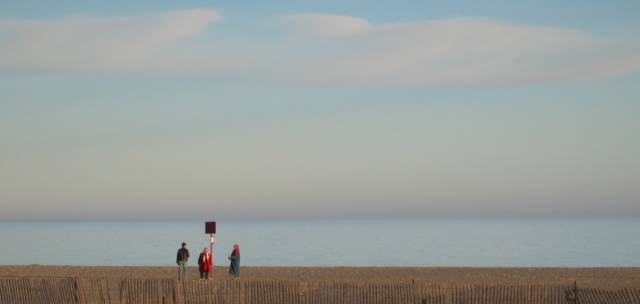
Ashbridges beach on Lake Ontario, one of the
Great Lakes. Often called inland oceans, they
really are huge. Here's some facts from a
website called great-lakes.net :
VOLUME
6 quadrillion gallons of fresh water; one-fifth of the world's fresh surface water (only the polar ice caps and Lake Baikal in Siberia contain more); 95 percent of the U.S. supply. Spread evenly across the continental U.S., the Great Lakes would submerge the country under about 9.5 feet of water.
TOTAL AREA
More than 94,000 square miles/244,000 square kilometres of water. (The area of Great Britain is 58,000 square miles)
About 295,000 square miles/767,000 square kilometres in the watershed (the area where all the rivers and streams drain into the lakes).
TOTAL COASTLINE
United States and Canada -- 10,900 mi/17,549 km (including connecting channels, mainland and islands). The Great Lakes shoreline is equal to almost 44 percent of the circumference of the earth, and Michigan's Great Lakes coast totals 3,288 mi/5,294 km.

Richard's skyline of Toronto. It's sometimes tempting to think of Toronto as the center of Canada. ;-) But in fact, the real geological center is somewhere quite different. I was a little awed to read this. Canada is so freaking huge. Facts from Canadian government website:
Extremities of the Canadian Landmass
* Most northerly point: Cape Columbia, Nunavut; 83 degrees 7 minutes North, 70 degrees 22 minutes West
* Most southerly point: Middle Island, Ontario; 41 degrees 41 minutes North, 82 degrees 40 minutes West
* Most easterly point: Cape Spear, Newfoundland: 47 degrees 31 minutes North, 52 degrees 37 minutes West.
* Most westerly point: A long portion of the Yukon-Alaska boundary which runs along the 141st meridian. The point at the southern end of this line would be the furthest west. This is at: 60 degrees 8 minutes North, 141 degrees 0 minutes West.
Centre of Canada
The centre of Canada can be measured in many ways. The most readily understood would be by taking the mid-point of the extremeties of the Canadian landmass section, above. The resulting location (62 degrees 24 minutes North, 96 degrees 28 minutes West) is located just south of Yathkyed Lake in Nunavut, about 150 kilometres northwest of Arviat, Nunavut.
Thursday, July 29, 2004
great smile at the pow wow at Wikwemikong Wikwemikong Unceded Indian Reserve No. 26 is nestled on the eastern side of beautiful Manitoulin Island and stretches across both Georgian Bay and Lake Huron in Ontario, Canada.
Wikwemikong is recognized as Canada's only Unceded Indian Reserve, meaning that the Wikwemikong Band has not relinquished title to it's land to the government by treaty or otherwise. "Wikwemikong" translated means "Bay of the beaver".
Wednesday, July 28, 2004
Tuesday, July 27, 2004
Sunday, July 25, 2004
Saturday, July 24, 2004
When that little voice in your head screams "No freaking way, you silly cow" it's a good idea to listen, lesson learned at climbing gym last week.
Friday, July 23, 2004
Thursday, July 22, 2004
meet your meat
If you think these little guys are cute, please download this movie. And for more information on why eating veggies is better than eating animals, check out Richard's essay on his website
Wednesday, July 21, 2004
Tuesday, July 20, 2004
Monday, July 19, 2004
my favourite links
Here's an old link page of mine when I had more time on my hands.
http://www.annedehaas.com/links.html
Sunday, July 18, 2004
We were biking up the Rouge River valley in the middle of nowhere and found this furniture just sitting there.. It was all uphill to that point so it didn't take much convincing to get Sally to pose in the LazyBoy. That's the "white trash" pose she's affecting there..because I forced her to do it... in real life she's very refined and elegant and holds her pinky up when she drinks tea.
Saturday, July 17, 2004

Collecting graffitti pics on Queen West when I noticed these two dear old ladies pobbling along. I missed the shot the first time they passed and was kicking myself. They went and sat on a bench and I hung around for a bit and they eventually got up and walked back the way they'd come, right past the graffitti wall.. bingo.
one of the Tibetan folk who work at the King's Cafe in Kensington Market, a great restaurant with really friendly staff.
More about Boyd
http://www.saveboydpark.ca/
Park Features
Boyd Conservation Area is an oasis at the edge of the city. Located in the City of Vaughan, just north of Toronto, the steep-sided Humber River Valley and tall trees offer a quiet refuge to the public. When combined with the Kortright Conservation area just to the north, the Boyd Ecological Complex is 2,500 acres of greenspace.
The Ministry of Natural Resource's records indicate the historical presence of one provincially endangered and two provincially threatened species within the area. The park contains 11 mammal species, 10 amphibian and reptiles, at least 237 plant species, 28 of which are species of conservation concern. The park represents the southern limit for many species.
The Park forms part of the Humber River natural heritage system. On September 24, 1999, the Humber River was designated as a National Heritage River. Construction of the Pine Valley Extension and bridge threatens this national treasure. Proposed construction activities could involve de-watering in excess of 50,000 litres per day. Other threats include stormwater run-of, erosion, siltation, contaminant spills, construction impacts, groundwater contamination and impacts on local wells. The Humber River in Boyd Park supports the nationally threatened redside dace, an exceptional fish that leaps into the air to snatch its prey. The site also contains robust wetlands that sustain numerous species and biological functions.
According to the Toronto and Region Conservation Authority, the Pine Valley Drive Link will negatively impact the larger ecological function of the Humber River natural heritage system. The solution is to include Boyd Park as part of the province's proposed Greenbelt, connecting this treasure to a larger, provincial-scale natural heritage system, called NOAH. NOAH would connect our province's most essential environment features, from the Niagara Escarpment, to the Oak Ridges Moraine, north to Algoquin Park, and finally to the Adirondack State Park in New York State.
Park Features
Boyd Conservation Area is an oasis at the edge of the city. Located in the City of Vaughan, just north of Toronto, the steep-sided Humber River Valley and tall trees offer a quiet refuge to the public. When combined with the Kortright Conservation area just to the north, the Boyd Ecological Complex is 2,500 acres of greenspace.
The Ministry of Natural Resource's records indicate the historical presence of one provincially endangered and two provincially threatened species within the area. The park contains 11 mammal species, 10 amphibian and reptiles, at least 237 plant species, 28 of which are species of conservation concern. The park represents the southern limit for many species.
The Park forms part of the Humber River natural heritage system. On September 24, 1999, the Humber River was designated as a National Heritage River. Construction of the Pine Valley Extension and bridge threatens this national treasure. Proposed construction activities could involve de-watering in excess of 50,000 litres per day. Other threats include stormwater run-of, erosion, siltation, contaminant spills, construction impacts, groundwater contamination and impacts on local wells. The Humber River in Boyd Park supports the nationally threatened redside dace, an exceptional fish that leaps into the air to snatch its prey. The site also contains robust wetlands that sustain numerous species and biological functions.
According to the Toronto and Region Conservation Authority, the Pine Valley Drive Link will negatively impact the larger ecological function of the Humber River natural heritage system. The solution is to include Boyd Park as part of the province's proposed Greenbelt, connecting this treasure to a larger, provincial-scale natural heritage system, called NOAH. NOAH would connect our province's most essential environment features, from the Niagara Escarpment, to the Oak Ridges Moraine, north to Algoquin Park, and finally to the Adirondack State Park in New York State.
Worth fighting for? I think so.
This is Moulann, an amazing Toronto musician. She's become my favourite muse. She's beautiful, athletic and completely at ease in front of the camera. Great for trying out new lighting arrangements.